If you've been told you need to "strengthen your core," "fix your posture," or "activate the right muscles"—but nobody's ever actually shown you how—you're in good company. That's one of the most common things I hear from patients walking through the door at Skare Spine & Performance.
Recently, I had the opportunity to explain DNS at Midwest Access, which opened the door to a deeper conversation about movement, pain, and why so many people struggle despite doing “all the right things.”
What Is DNS? (The Simple Version)
DNS stands for Dynamic Neuromuscular Stabilization. And while that's a mouthful, the idea behind it is actually pretty straightforward.
DNS is a rehabilitation approach built on the premise that your body already knows how to move well—it just needs to remember how. Every healthy baby on the planet goes through the exact same sequence of developmental milestones: rolling, crawling, sitting, standing, walking. That sequence isn't random. It reflects how the brain, nervous system, joints, and muscles are wired to work together.
Babies aren't strong in the way we typically think of strength. They're coordinated. They're stable. They breathe perfectly, they sit effortlessly, and they move without unnecessary tension. DNS is about getting adults back to that baseline.
Why Most Adults Have Lost These Patterns (And Don't Know It)
Life gets in the way. Desk jobs, stress, old injuries, habits we've picked up over decades—they all chip away at the movement patterns we were born with. Over time, the brain stops recruiting the right muscles at the right time. Other muscles overcompensate. And eventually, that compensation shows up as pain.
This is why I see so many patients who've tried everything—stretching, strengthening, even surgery—and still can't get ahead of their pain. They're treating the symptom, not the pattern. DNS is about going upstream and fixing the root cause.
It All Starts with Breathing
Here's the part that surprises most people: DNS starts with breathing.
Breathing is the first movement pattern we ever develop, and it lays the foundation for everything else—core stability, spinal support, neck and shoulder function, low back health. When breathing mechanics break down, everything downstream is affected.
Most people don't breathe well and have no idea. They breathe into their chest, up into their neck and shoulders, with way too much tension throughout. This overworks the wrong muscles and leaves the core doing nothing. DNS retrains breathing so your rib cage expands properly, your deep core actually activates, and your spine gets the support it needs.
Honestly, some patients notice their pain improving before we've even moved on to anything else—just from relearning how to breathe.
DNS vs. Traditional Core Training: What's the Difference?
Most people think of core training as crunches, planks, and bracing. That's not DNS.
DNS is less about building strength in individual muscles and more about teaching muscles to work together automatically. It focuses on proper joint positioning, coordinated activation, and maintaining stability while you're actually moving—not just while you're holding a static position on a gym floor.
The goal is to restore the body's natural ability to stabilize itself. When that happens, movement becomes more efficient, and you stop relying on muscles that were never designed to carry that load.
How DNS Helps with Low Back Pain in Rochester, MN
Low back pain is one of the most common reasons people come see me here in Rochester. And one of the most important things I've learned is that not all low back pain is the same—which means treating it all the same way doesn't work.
With DNS, I'm assessing how you breathe, how your core controls movement, how your hips and pelvis function, and how load gets distributed through your spine during everyday tasks. What we usually find is a combination of muscles that are overactive and tight, and others that are completely checked out. The body has been running on compensation for so long that it has forgotten what good stabilization even feels like.
DNS helps turn off the muscles that are working overtime and re-engage the ones that should be doing the job. The result is usually less pain with less effort—and results that actually stick.
DNS for Neck and Shoulder Pain
Neck pain is another area where DNS really shines. The majority of people I see with chronic neck tension are breathing through their neck and shoulders all day without realizing it. They hold stress there, they lack deep neck and shoulder stability, and those surface muscles are just fried from doing double duty.
DNS uses specific positions and gentle resistance to activate the deep stabilizers at the front of the neck, quiet down the overworked muscles at the back, and build better support through the upper back and shoulders. It's not about stretching the neck more—it's about changing the whole pattern.
Why DNS Looks Subtle but Doesn't Feel Easy
DNS exercises can look simple from the outside. But the first time most patients do them, they're shaking within 30 seconds, muscles firing that they've never felt before.
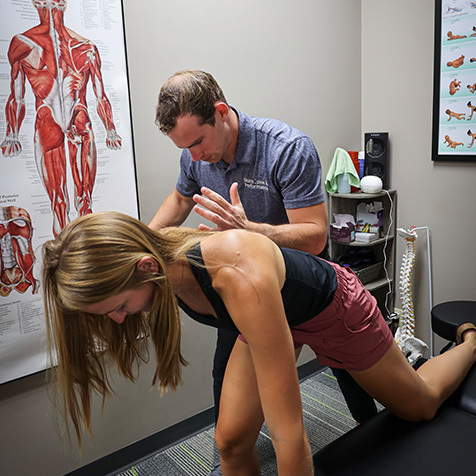
That's because DNS is targeting muscles that are underused—not necessarily weak, but disconnected. Your nervous system has stopped calling on them. With hands-on cueing and feedback, I help guide your body into the right position so the nervous system can re-learn what correct actually feels like. Once it clicks, it tends to stick.
DNS Takes Time—And That's the Point
DNS is not a quick fix. Just like going to the gym, retraining movement patterns requires consistency. But the difference is what you're building.
Instead of chasing pain from one area to another—treating the back, then the hip, then the shoulder—DNS improves the foundation that all of those areas rely on. Small improvements compound over time, and you end up with better function, fewer recurring injuries, and longer-lasting results. That's the goal.
Who Is DNS Right For?
At Skare Spine & Performance, I use DNS with a wide range of patients—from office workers dealing with chronic neck pain, to weekend warriors trying to stay ahead of recurring injuries, to athletes who want to move better and perform at a higher level. I also work with infants and kids, because DNS is rooted in developmental movement and applies across the entire lifespan.
The common thread isn't age or fitness level. It's a body that has drifted away from the movement patterns it was designed to use.
DNS as Part of an Integrated Approach at Skare Spine & Performance
One of the things I'm most proud of at our practice is that we rarely use any single tool in isolation. DNS gets integrated with chiropractic adjustments, manual therapy, dry needling, shockwave therapy, and functional strength training—depending on what you need. That means we're addressing joints, muscles, movement patterns, and nervous system control in the same visit. It's a much more complete approach than anything you'll find at a traditional chiropractic or PT clinic.
Ready to Get Started? Here's What to Do Next.
If any of this resonates with you—if you're tired of short-term fixes, chasing pain from one spot to another, or just want to understand why your body keeps breaking down—start with a comprehensive evaluation. We'll assess how you breathe, how you stabilize, and how you move, and build a plan from there.

Nate Skare
Contact Me